
Moira Primary School at the heart of the National Forest
Mental Health and Wellbeing at Moira

Mental Health and wellbeing not only has a huge impact on our ability to learn but contributes to our ability to lead positive, purposeful lives. At Moira, we are committed to supporting and advancing the emotional wellbeing of our school community. This year we were delighted to receive the Wellbeing in Schools Award, which is recognition of the policies and initiatives we have in place to support the improvement in the emotional health and wellbeing of pupils and staff. If you have any concerns, please do not hesitate to contact us.
This page provides helpful links for parents (see the bottom of the page) and will keep you up to date with the opportunities we offer to support our children's well-being and mental health.
Wellbeing toolkits for parents
Working With Parents
- NHS Leicestershire 'Looking After Yourself' -An Emotional Health and Wellbeing Kit for Chirldren
- E-Safety for Parents
Coronavirus Support
ELSA
ELSA - Emotional Literacy Support Assistant.
There will always be children in schools facing life challenges. These situations and the emotions that follow detract their ability to engage with learning effectively - our ELSAs in school help our children get through these struggling times. Some children require greater support than others and need a range of tools/strategies to increase their emotional literacy and resilience. ELSA is an initiative that was originally developed and supported by Educational Psychologists and they recognised that children learn better and are much happier in school, if their emotional needs are addressed.
We are lucky to have a qualified Emotional Literacy Support Assistant at Moira Primary - Miss Johnson. She has been trained by Educational Psychologists to plan and deliver programmes of support for pupils who are experiencing temporary or longer term emotional needs. Miss Smith one of our experienced LSAs has started her training to become an ELSA too.
The majority of ELSA work in school is delivered on an individual basis, but sometimes small group work is more appropriate, especially in the areas of social and friendship skills. Sessions are based in our Nurture Room, a calm, welcoming, safe space for the child to feel supported. The sessions are fun and we use a range of activities such as: games, role-play with puppets or therapeutic activities such as mindfulness or arts and craft.
In ELSA we aim to provide support for a wide range of emotional needs:
- Recognising emotions.
- Anxiety.
- Self-esteem.
- Social Skills.
- Friendship skills.
- Anger Management.
- Loss and bereavement.
How does ELSA work?
Children are usually referred for ELSA support by their Class Teacher or Senior Leaders. Every half term our ELSAs will meet with Mrs Santy to discuss the referral forms, to identify and prioritise which children require a 6 week programme. With the programme aims in mind, they then plan support sessions to develop new skills and coping strategies that allow our children to manage social and emotional demands more effectively.
Supporting - not fixing
Remember, ELSAs are not there to fix children's problems and they are not counsellors. They provide emotional support for children. Our ELSAs aim to establish a warm, respectful relationship with a pupil and provide a reflective space where they are able to share their thoughts and feelings honestly.
It needs to be appreciated that change cannot be achieved rapidly and success is dependent upon the context and complexity of the presenting issues. For children with complex or long-term needs it is unrealistic to expect ELSA intervention to resolve all difficulties, however support will be designed to target specific aspects of the child's needs.
Training and development of ELSAs is an ongoing process. A great deal of wisdom is required as well in order to recognise when specific issues are beyond the level of expertise of an ELSA. In these cases, school signposts parents/carers via referrals for specialist counselling, play therapy or to CAMHS.
Individual objectives are set with the child in partnership with the parent/carer, class teacher and occasionally outside agencies. ELSA sessions provide the time and space for validation of the child’s feelings and there are plenty of opportunities to work towards a solution.
Healthy Schools Award
The Healthy Schools Award is reviewed every two years in school to ensure that children are learning about their health and well-being to a high standard. Here at Moira it very much underpins everything we do. We are proud that our Healthy School Award was reviewed and approved in the Autumn Term 2018.
Mental Health and Well Being Award
At Moira, we understand the importance of creating a positive, supportive environment which places the emotional wellbeing of our community at the heart of everything we do. We are delighted to be accredited with the Well Being Award for Schools which echoes the ethos we deliver. They state:
Developed in partnership with the National Children’s Bureau (NCB), the Wellbeing Award for Schools is intended to help schools prepare and equip themselves to promote emotional wellbeing and positive mental health across the whole-school community. NCB’s vision is an education system where good emotional wellbeing and mental health are at the heart of the culture and ethos of all schools, so that pupils, with the support of their teachers, can build confidence and flourish. Evidence shows us that wellbeing is of central importance to learning and attainment, with high levels of wellbeing associated with improved academic outcomes. Conversely, pupils who have mental health problems are more likely to have academic difficulties at school and experience social disadvantage later in adult life.
There are four key principles driving the ideas and recommendations behind the award:
- Emotional wellbeing and mental health are a continuum. Related issues can range from positive attitudes and behaviour, through to experiences of emotional distress and mental disorder.
- Schools already experience and manage emotional issues on a daily basis; the objective is to minimise the impact of such issues and maximise the effectiveness of any responses.
- Emotional wellbeing covers a range of dimensions, such as resilience, character building, relationships and self-esteem, etc. Understanding both developmental and mental health awareness is critical.
- Creating a positive school culture requires a whole-school approach that is led from the top while involving all in the school community.


Anti-Bullying
At Moira, our broad curriculum, alongside our core values of 'Together We Try' and character strengths, ensure that our children experience and develop an appreciation of the diversity within our school and in the wider world. In doing so, the children learn about the importance of respect, equality and tolerance as well as learning how to interact positively with other people who may hold different views or ideas to their own. We aim for our children to be caring, considerate and respectful individuals.
This section underpins this work by providing links to anti-bullying websites and literature to support you and your child. Should you feel that your child is unhappy or requires support please speak to your child's class teacher as soon as possible.
We are very proud to be accredited with a Beyond Bullying Award. You can find out more and find helpful information by clicking on the link below.
Here are a few helpful links and leaflets. Leaflets can also be found in just inside the Key Stage One entrance.
A and D Inclusion
At Moira we are fortunate to have a nurture room which enables us to provide additional support to individual children and small groups. It is a multi-purpose room and provides a safe and calm environment for the children to work on their well-being.
As a school, we have bought into the services of A and D Inclusion which is run by Angela Peach and Dawn Christian. Both ladies are qualified youth workers who have been working in local primary schools and for Leicestershire County Council for several years. Sessions take place on a weekly basis and last between twenty to thirty minutes. Work undertaken is usually very informal "just talking", playing games and doing activities designed to help students express their feelings and emotions in positive and healthy ways. The children thoroughly enjoy these sessions and find them extremely beneficial with the affectionately known "Nice Ladies".
A and D Inclusion
Team Six Buddies
There is an awful lot going on when you become a member of Team Six. You are now at the top of the school, a role model to the younger children, your body is starting to change, you have SATs and you know that it won't be long before you are moving onto secondary school. To help our Team Six, each child has a member of staff who is their buddy. Someone they can talk to if they have any worries, questions or just need a chat. The children choose their own buddies and are guaranteed the time and support they need in this crucial year.

Supporting Bereaved Families
Supporting Bereaved Families.
By the age of sixteen, one in every twenty-nine children or young person will experience the bereavement of a parent or sibling. Furthermore, 78% will report being bereaved of someone to whom they were close by the age of 16. Other children will experience the loss of a loved one through altered home circumstances, such as family breakdown. 1.
How we handle bereavement varies from person to person. Factors such as the circumstances of the person’s death as well as the child’s level of understanding about death will be contributory factors on the level of support needed. At Moira, we recognise that bereavement can have a significant impact on a child’s future wellbeing and can offer practical advice and signpost places of support to bereaved families.
Often being at school at such times, can provide the child with safety and routine when everything else in their lives can seem to have changed. In other words, whilst supporting the child sensitively, school also gives a sense of normality. Should you have any questions about this or wish to inform the school of a bereavement, please contact Mrs Coates, Mrs Santy, Miss Johnson or your child’s class teacher.
Places for support:
Childhood Bereavement Network: www.childhoodbereavementnetwork.org.uk
Childline: www.childline.org.uk
The Child Bereavement Charity: www.childbereavement.org.uk
Winston’s Wish: www.winstonswish.org.uk
The Laura Centre: www.thelauracentre.org.uk
CRUSE bereavement care: www.crusebereavement.org.uk
Samaritans: www.samaritans.org
Young Minds: www.youngminds.org
1. Bereavement in Primary Schools: A Guide, Wellbeing Education.
Supporting Bereaved Families.
By the age of sixteen, one in every twenty-nine children or young person will experience the bereavement of a parent or sibling. Furthermore, 78% will report being bereaved of someone to whom they were close by the age of 16. Other children will experience the loss of a loved one through altered home circumstances, such as family breakdown. 1.
How we handle bereavement varies from person to person. Factors such as the circumstances of the person’s death as well as the child’s level of understanding about death will be contributory factors on the level of support needed. At Moira, we recognise that bereavement can have a significant impact on a child’s future wellbeing and can offer practical advice and signpost places of support to bereaved families.
Often being at school at such times, can provide the child with safety and routine when everything else in their lives can seem to have changed. In other words, whilst supporting the child sensitively, school also gives a sense of normality. Should you have any questions about this or wish to inform the school of a bereavement, please contact Mrs Coates, Mrs Santy, Miss Johnson or your child’s class teacher.
Places for support:
Childhood Bereavement Network: www.childhoodbereavementnetwork.org.uk
Childline: www.childline.org.uk
The Child Bereavement Charity: www.childbereavement.org.uk
Winston’s Wish: www.winstonswish.org.uk
The Laura Centre: www.thelauracentre.org.uk
CRUSE bereavement care: www.crusebereavement.org.uk
Samaritans: www.samaritans.org
Young Minds: www.youngminds.org
1. Bereavement in Primary Schools: A Guide, Wellbeing Education.
Outside Agencies (Local and National)
Mental Health Support in Leicester City, Leicestershire and Rutland. A Services Guide for children, young people and families.
Local Help
Your GP They will be able to provide help and advice. Your GP can also provide access to appropriate specialist services and local organisations.
Call 111 You can call 111 when you need medical help fast but it’s not a 999 emergency. NHS 111 is available 24 hours a day, 365 days a year. Calls are free from landlines and mobile phones.
NHS mental health services Find local mental health services on the NHS website. http://www.nhs.uk
National Help
Action for Children - Charity supporting young people and their families across England. http://www.actionforchildren.org.uk
Anxiety UK - Advice and support for people with anxiety. 03444 775 774 (helpline) 07537 416 905 (text) http://www.anxiety.org.uk
Childline Free 24-hour counselling service for children and young people up to their 19th birthday.
0800 1111
Mind – Infoline Offers advice and support to service users; has a network of local associations in England and Wales to which people can turn for help.
0300 123 3393, text number: 86463
SANE Provides practical help, emotional support and specialist information for people aged 16 and over with mental health problems, their family, friends and carers.
0300 304 7000
Supportline Confidential telephone helpline offering emotional support to any individual on any issue.
01708 765200
Beat Provides helplines, self-help groups and online support to anyone affected by eating disorders.
Helpline: 0808 801 0677,
Youthline: 0808 801 0711,
Studentline: 0808 801 0811
The Samaritans The Samaritans provide a confidential service for people in despair and who feel suicidal.
116 123
NSPCC Provides helplines and information on child abuse, child protection and safeguarding children.
0808 800 5000
Hope Again - Support for young people when someone dies. www.hopeagain.org.uk or 0808 808 1677
Kooth - Counsellors available until 10pm every day. Free, safe and anonymous online counselling for young people.
Young Minds Young Minds has a Parent Helpline that offers free confidential telephone and email support to any adult worried about the wellbeing of a child or young person.
0808 802 5544
http://www.youngminds.org.uk/for_parents
Youth Wellbeing Directory
Helps you find support for mental health and wellbeing of young people up to age 25 across the UK.
https://www.annafreud.org/on-my-mind/youth-wellbeing/
HaveIGotAProblem.com
Free resource about mental health and addiction issues. It has advice and documents on issues including depression, anxiety, self-harm, bipolar, eating disorders and coping.
http://www.haveigotaproblem.com/
Helplines partnership
Provides a comprehensive list of mental health helplines in the UK.
https://helplines.org/helplines/
Mental Health Foundation This website offers a wide range of information about mental health issues.
http://www.mentalhealth.org.uk
Health Talk Online
Aims to provide balanced information about the experience of everyday life with a range of health conditions and issues, what to expect both physically and mentally, overcoming practical difficulties, making decisions about treatment and talking to health professionals.
OCD Youth - Youth support for young people with obsessive-compulsive disorder (OCD) ocdyouth.org
On my mind - Information for young people to make informed choices about their mental health. annafreud.org/on-my-mind
YouthinMind
YouthinMind is an online resource for information about mental health and offers brief assessments. It also provides links to other useful books, websites and services. http://youthinmind.info/py/yiminfo/
Supporting Children
Talking Mental Health
Talking Mental Health is an animation designed to help begin conversations about mental health in the classroom and beyond.
Healthy Eating
Looking for a few ideas for your child's lunch box? Why not have a look at the Change 4 Life website for a few recipe ideas.
Book List
Below are a list of books that may be useful in supporting your child's emotional wellbeing.
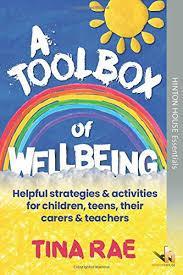
This recently published book by Tina Rae is for use at home and school by people concerned with the wellbeing of children, with much-needed practical advice and ideas to support you in protecting mental health and wellbeing at a time of uncertainty and fear.
These therapeutic tools, ideal for use by non-specialists, will provide an excellent means of developing a whole-school culture of support and nurture as young people transition back into school after what, for many, will have a stressful period of lockdown.
Contains user-friendly and evidence-based strategies to build good mental health and develop the resilience needed to move on from stressful situations and trauma – including those related to the Coronavirus pandemic.